#6 Pay Attention!
Many moments are made from simply PAYING ATTENTION
Steve Steele
6/8/20266 min read
The Moment Is Already in the Room
There's a version of leadership development that looks like this: you read the books, you attend the conferences, you study what the best organizations in the country are doing, and then import their best practices into your own situation. There's real value in that instinct. I've done it myself, and it has made me better.
Another version is much quieter and less glamorous but more powerful and easier to implement. This version is where the answer you've been searching for was never somewhere else to begin with. It's where the analytical mind you needed was in your Biology class, or the coach you knew was brilliant was unhappy at another school. It's where the answer you needed was in the room with you the whole time.
You just weren't paying attention.
The Kick
Here's a version of paying attention that happened in about thirty seconds.
Our 2021 State Championship against Tea Area began about as good as it could...if you were Tea. We fumbled the opening kickoff, then our next possession, and again on the possession after that. The game was barely underway, and we were already trailing 21-0. We finally managed to get on the board just before halftime, but sure enough Tea would score to open the second half and take a three possession lead again.
We fought all the way back with a few quick Touchdown passes from Lincoln Kienholz to Jett Zabel and then a grinding run game to tie the game 27-27 with under three minutes left. Tea drove into field goal range. Then, Jacob Mayer made an interception that was reviewed for over four minutes before we ultimately got the ball (still the loudest single roar I've ever heard at the dome).
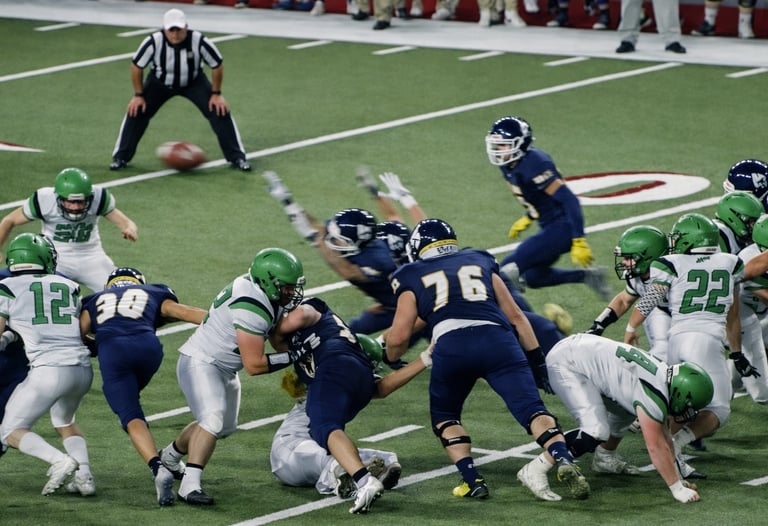
With 36 seconds left on our own 26-yard line, we moved the ball 51 yards in 32 seconds and spiked the ball with four seconds left on the clock. We called our final timeout to set up the field goal.
Cole Peterson was our kicker. He was about to attempt the most important kick of his life. A kick with the weight of the state championship game on it and after a four-minute delay. I've watched many college and pro kickers feel that pressure and miss. What would happen to our high school kicker?
During our last timeout, I went to find Cole while Naasz worked with our shield. In that moment we had maybe 30 seconds to truly figure out what to say. In the seconds walking out us coaches were chatting about the direction to go on our headsets, discussing what we thought Cole needed. As a coach, more importantly than what you want to say, you have to know your players and guess what they need to hear in moments like these. We chose a simple three word answer with direct eye contact and a quick tap on the shoulder.
All I said to him was: "Be the hero."
Tea called a timeout to ice him so we got another moment together. We chose not to add any more words. I just gave him a nod and slapped his hand.
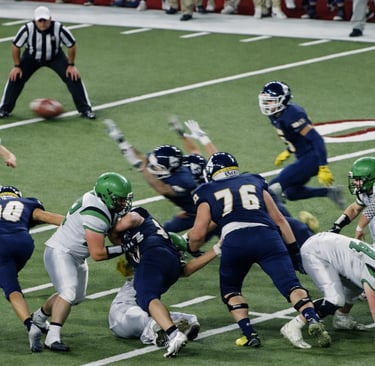
The TV broadcaster referred to Cole as "someone who looks like one of the Little Giants." His kick missed being blocked by millimeters (legitimately) and went through the uprights. Cole became the hero. We were State Champions for the fifth time.
The decision surrounding our three word conversation had to be made in just 30 seconds. We had to make it with the information we had at the time and hope we could give him what he needed. Prior to this moment, after our final touchdown, Cole's extra point kick attempt had been blocked and he was crushed. He had come off to the sideline hoping he wouldn't be the reason the game went to overtime. What Cole needed in that moment was belief and confidence. Less was more. Knowing that required paying attention to what Cole needed after what had just happened. He didn't need a tactical reminder, technical correction, or a short speech. He needed someone to look him in the eye and tell him he was capable of what was being asked of him.
If we had been hyper-focused running through overtime contingencies, we might have gone to Cole with a clipboard full of instructions. Instead, we gave him with three words because our staff was paying attention to the person, not just the situation.
The Answer on the Hockey Trip
A few years into our run in Pierre, our football staff was struggling to find a theme for the upcoming season. Each year we build our season around a central idea. A theme that captures who our team is and what they are chasing. Some years the theme arrives easily. This wasn't one of those years.
We had tried the usual process. We talked about the roster and talked about what the team needed and came up empty. Nothing was landing with the conviction we needed to build a whole season around it. Lots of ideas, but none with any depth to them.
Then on a hockey trip, Jon, one of our hockey coaches, was running some music during our travels. A song came on, Hope by NF. The lyrics fit our team's situation so precisely. The lyrics fit the exact challenges we were facing, the exact thing we needed to say to that particular group of young men. It felt like a big deal on that car ride, because it almost seemed as if it was written specifically for us.
I pulled out my phone immediately. I found the song and sent it to the rest of the football staff. That song ended up being the backdrop of our hype video and we built our entire season around it.
The answer to a problem we had been turning over for weeks arrived in thirty seconds of a playlist in a car on the way to a hockey game. It only came to be because I was present enough to catch it, and then able to act on it immediately.
That's what paying attention actually looks like. It's not always a breakthrough moment in a planning session or the result of a deep strategic review. It's just someone fully showing up to the moment they're already in and noticing what is already there.
What Paying Attention Actually Requires
The Heaths are direct about this in The Power of Moments: most leaders don't fail at creating moments because they lack generosity or good intentions. They fail because they aren't paying attention. They're moving too fast, managing too many things at once, living inside their own heads. Much of the raw material of a potentially defining moment passes by completely unnoticed.
This is harder to solve than it sounds, especially today. In an era of smartphones, social media, and noise that never stops, genuine presence is extremely rare. I am not immune to this. I've been in conversations where I was physically there but mentally somewhere else entirely. I've missed things I should have caught.
The reason I talk about paying attention isn't because I've mastered it. It's because I've seen what it produces when I do it well, and what it costs when I don't. No matter how good or bad you are at being present, there's always room to improve. Doing so can give you more opportunities and ingredients to make more moments happen.
A kicker who needed three words almost got a clipboard. The theme for a season almost didn't happen because nobody was listening to the music.
Both of those moments were already in the room. I just had to be present enough to see them.
Present Before Purposeful
Everything in the Momentous Leadership framework, from the five-minute rule to the moment for the person nobody sees and to the intentional act of recognition requires this as its foundation. You cannot be intentional about what you haven't noticed. You cannot create a moment for someone you haven't truly seen.
Presence comes before purpose. Attention comes before action.
This means something practical about how you move through your day. It means putting the phone down when someone is in front of you. It means arriving at practice, at a meeting, at dinner with your family, and making a conscious decision to actually be there. Not planning the next thing. Not reviewing the last thing. There.
It means treating every interaction as one that might be carrying something important. It could be something you need, or something the person in front of you needs. You must be there to notice it.
Again, Cole's field goal required us to see past the clipboard and into the kid. The song in the car required someone to be listening.
The moments are already in the room. The only question is whether you'll be present enough to find them.
PARTING THOUGHTS
Think about the last week. How many conversations did you have where you were physically present but mentally somewhere else? What might you have missed?
Jon's song on the bus, Cole's moment before the kick. Neither of these required any extra time or planning. They only required presence. Where in your schedule are you physically there but not truly paying attention?
The Heaths argue that most leaders leave the defining moments in people's lives entirely to chance not out of indifference, but out of distraction. What is pulling your attention away from the people in front of you?
Who in your program or organization is carrying something right now that you haven't fully noticed yet? What would it take to see them more clearly this week?